



Molecular Diagnostics
→bROC: Analysis of gene expression in microarray and high throughput experiments
bROC (Bootstrapped ROC) is a novel algorithm is used in the discovery of differentially expressed probes/genes
in differential expression experiments. It is available as a plugin for CLC bio Main Workbench and Genomics Workbench.
The algorithm has been tested on Affymetrix GeneChip and Illumina Genome Analyzer data.
The algorithm should be applicable to data from all expression platforms that produce measurements for a large number of molecular entities.
DNA microarray and next generation sequencing (RNA-seq) technologies enable simultaneous profiling of thousands of transcripts and/or genes in cells or tissues.
Their current applications include gene profiling, gene regulation studies, disease biomarker discovery,
toxicogenomics, pharmacogenomics, and clinical diagnostics and prognosis.
Benefits of the bROC algorithm include:
- Works particularly well for experiments with a small number of experimental/biological replicates.
- Non-parametric approach is applicable to all platforms producing expression data for a large number of features (transcripts, genes).
- Includes data normalization (for RNA-seq, mainly).
- When combined with RNA-seq Analysis (CLC bio), provides complete differential expression analysis workflow for RNA-seq data.
- Graphical outputs facilitate interpretation of results.
- With no user-selectable parameters, the algorithm is easy to use.
White paper, microarray analysis (PDF)
RNA-seq Application Note (PDF)
Poster presentation (PDF) - 2010 Meeting of the American Society of Human Genetics.
→PdCCA: High sensitivity detection of cancer biomarkers
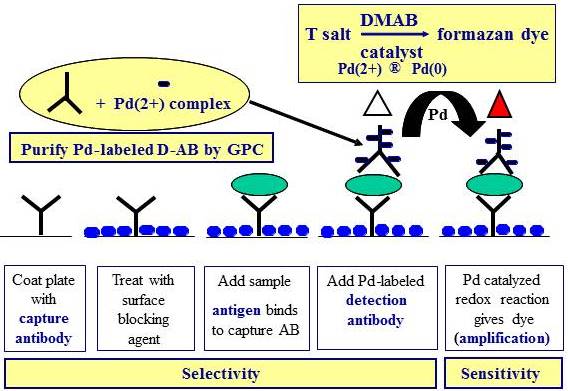
BioFormatix is studying the use of proprietary Palladium Catalyzed Chemical Amplification (PdCCA) technology
to develop ultra-sensitive bioassays that can detect very low concentrations of tumor biomarkers in blood.
Detection of cancer in the early, asymptomatic stages dramatically improves patients survival, but currently
there are no simple and reliable molecular diagnostic cancer screening tests. Even at early stages, tumors
secrete specific molecular biomarkers, but their concentration in body fluids is typically significantly
below the sensitivity of currently available assays. More sensitive detection platforms will facilitate
the development of simple, non-invasive screening tests for early cancer diagnosis and treatment, leading
to improved patient survival.
PdCCA is a generic technology that can be universally applied to different assay platforms. In the standard
ELISA format, PdCCA may provide a factor of 102 to 103 fold increase in sensitivity in immunoassays for
which a detection antibody of high selectivity is available. This increase in sensitivity will lower
the detection threshold of currently used methods to the desired range of ng-pg/ml, allowing for
development of screening biomarkers for early tumor detection.
The current feasibility study, performed in collaboration Fred Hutchinson Cancer Research Center
focuses on early biomarkers related to ovarian cancer and breast cancer.
The research is funded by an SBIR grant from the NIH National Cancer Institute.
PdCCA modified sandwich ELISA bioassay