




Perimetry
The Visual field (VF) test is a widely used, noninvasive technique for evaluating pathology or dysfunction in the visual pathways. It is one of the basic diagnostic tools of ophthalmology. The VF test, in conjunction with other diagnostics, is especially useful in the detection of glaucoma and for following its progression.
→VFExpertTM / GSP: Diagnostic aid software for the visual field test
Early detection of glaucoma is critical, as blindness from the disease is preventable in nearly all cases if treatment is promptly administered. BioFormatix has applied novel machine learning approaches to the problem of glaucoma diagnosis via an automated analysis of visual field data. Our integrated and user friendly decision-aid software program facilitates and standardizes the task of interpreting the visual field test by providing a reliable and detailed classification of glaucomatous and non-glaucomatous defects. The newly devised GLI (glaucoma likelihood index) provides numerical summary of a multi-level classification and may be potentiallly used as a measure of glaucoma progression. Customized versions of VFExpertTM program are used by:
- Oculus perimeters GSP – Glaucoma Staging Program (Oculus GmbH)
- VirtualEye® head-mounted perimeter
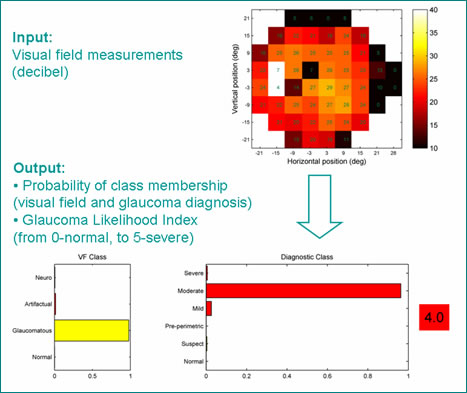 |
VFExpertTM produces clinically relevant classifications of perimetry measurements |
Publication download:
Glaucoma detection and evaluation through pattern recognition in standard automated perimetry data
→VirtualEye® Perimeter: Testing of visual field with virtual reality goggles
VirtualEye® is a lightweight, high-performance head-mounted apparatus for the visual field test. The device
permits unprecedented freedom of movement of the head and body, thus minimizing the stress and fatigue
commonly associated with conventional visual field testing systems.
A flexible, computerized platform and state-of-the art display technology enables easy re-configuration
of the system to accommodate emerging and future test scenarios. Onboard gaze tracking device increases
test reliability and accuracy, and enables hands-free operation.
The device performs the equivalent of full threshold 24-2 visual field testing in two modes: (1) manual
(subjective), with patient response registered with a mouse click and (2) visual grasp (objective), where
the eye tracker senses an appropriate change in gaze as evidence of target acquisition.
Clinical studies showed high level of patients' satisfaction with the device comfort and performance
(most subjects preferred VirtualEye over the standard stationary perimeter), and its usefulness in testing
of the visual field.
Testing of Visual Field with Virtual Reality Goggles in Manual and Visual Grasp Modes (free download)
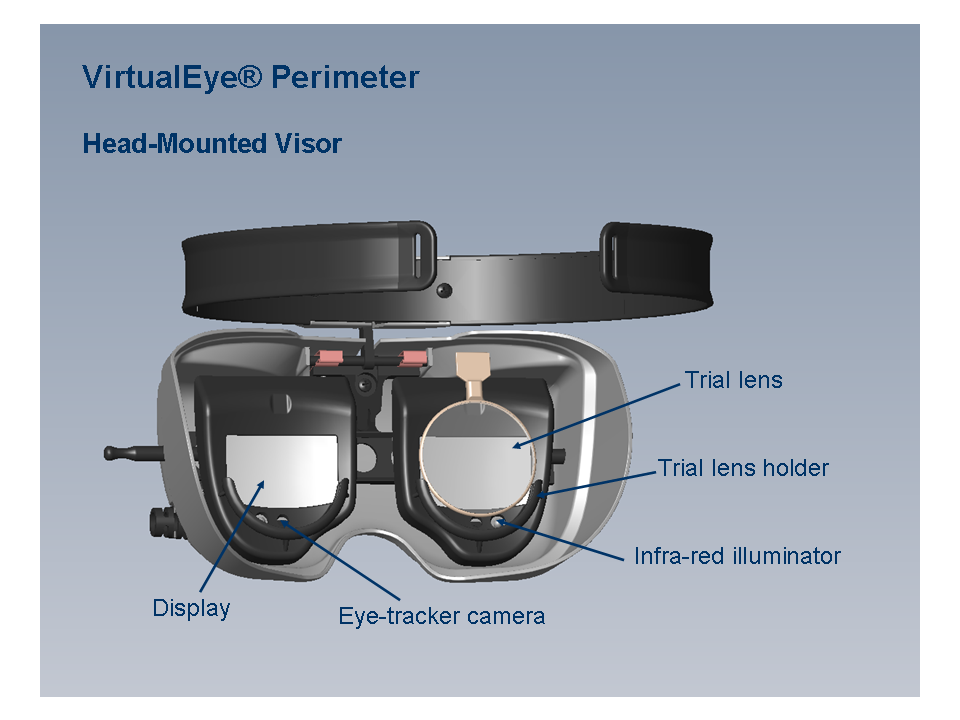 |
Patient's view of VirtualEye head-mounted visor. The device is secured on patient's head with adjustable headband (top of the picture). |
Components of VirtualEye Perimeter | 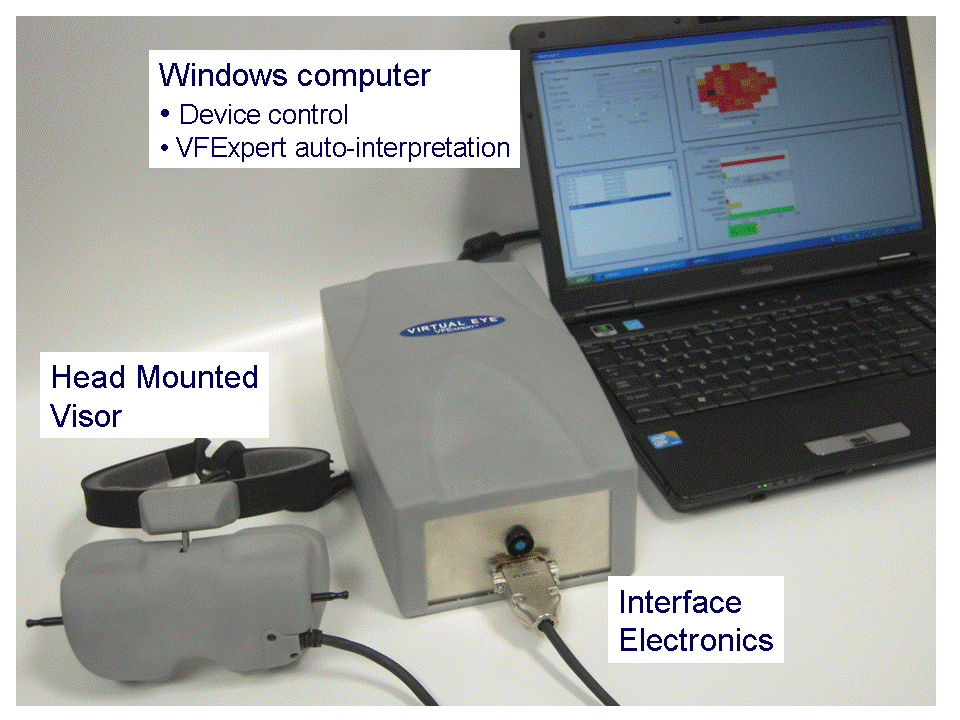 |
→HFA Import: Easy download of digital data from HFA II perimeter
HFA_Import is a program for semi-automatic download (import) of test data stored on HFA II perimeter (Carl Zeiss Meditec) to an Excel file. The program uses serial port connection between host computer and the perimeter.
Presently, only test points corresponding to 24-2 test locations are imported. 30-2 tests can be imported, but only 24-2 test points will be stored. Also, due to the limitations imposed by Carl Zeiss Meditec, only 'raw' sensitivity (threshold) values for the visual field may be imported. The processed data such as standard deviation and standard pattern deviation are not available.
HFA_Import runs on a personal computer under all versions of MS Windows®. The computer must be equipped with a serial port (or, a serial port adapter). MATLAB Compiler Runtime (MCR) is required to run the program and is included in the installation package.
Download the program manual (PDF) or use the Contact page to request a free trial version.